

Hey, what's up, aquam Migos? How are you guys doing today? So today, we're actually going to be taking a break from the Koon build in this video. I actually got this solar-powered pump sent to me by the brand Poposoap. It's right here inside this box, and inside that box should be a small water pump, a solar panel, and some attachments. In today’s video, I want to show you something. I plan to use it to create a patio bowl for the summertime. This will allow me to keep some of my guppies outdoors again. You may have seen me do this in the past.
Product Overview and Unboxing

So, I'll go ahead and put the Amazon link for this down in the description below. It goes for $89, and yeah, let's go ahead and get started by opening it. All right, guys, so pretty cool. If we take a look at the solar panel over here, we'll see that it's almost the size of the box. I mean, it's a pretty decent size. I'll go ahead and put my foot next to that for some reference. Then we have the pump over here. If we take a look at the front of the pump, there's a knob right there that you can turn, and the instructions say that that's called the rotary control valve.
Pump Features and Assembly

So I'm not 100% sure yet what that does. I’m sure I’ll figure it out once I start putting it together. My guess is that it has something to do with controlling the water flow. As you can see, there is a plus and minus symbol. So I'm assuming plus will be for higher flow, and minus will be for lower flow, but yeah, let's go ahead and see. These look like some extra pre-filters for the front end of the pump. If we go ahead and open the pump up real quick, um we'll see that there is one of those sponges in here. So I’m going to go ahead and put this together. I’ll start by hosing out the pre-molded mini pond I have.
Setting Up the Mini Pond

I'm going to set it up probably right here. It would be nice if I set it up basically, like, maybe in front of that small table. All right, guys, I’m filling it up with water right now. I’m probably only going to fill it about halfway. That’s because I’m not completely sure I’m going to leave it here. I might end up moving it somewhere else, but just to test it out for today and make sure everything works, I'll set it up here for now.
Optional Battery Backup
I was just taking a look at the instructions, and I thought this was pretty cool. There’s an optional battery backup you can buy. It helps supply power to the pump when there isn’t enough sunlight. That’s actually pretty cool. So the pump can actually keep running even when the sun's not out. All right, guys, so this is what we have so far. I attached the fountain piece to the top. This way, it sticks out of the water and creates a small fountain. Also, I went ahead and turned the knob all the way to the plus side.
Performance and Solar Panel Efficiency

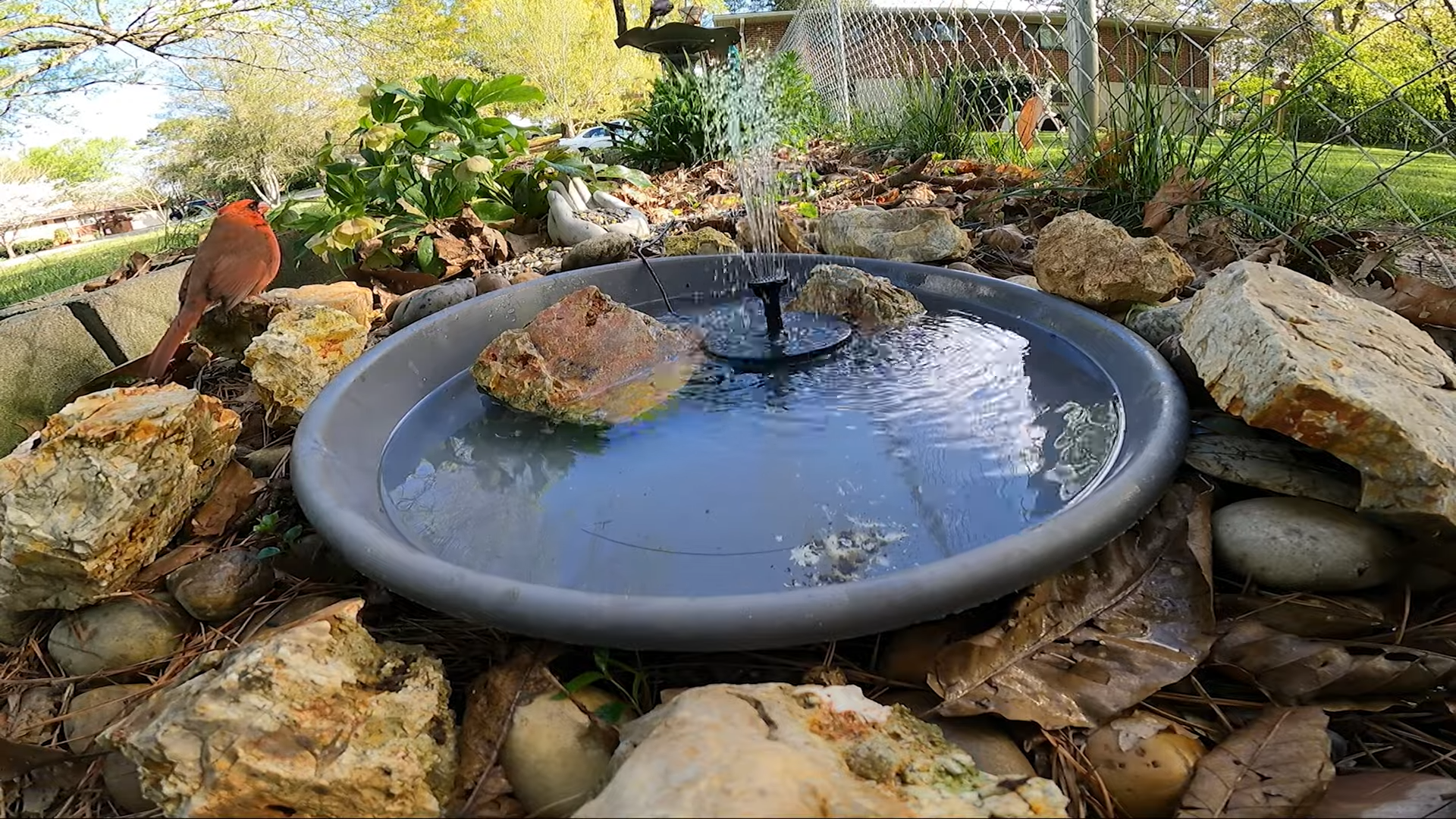
Wow, I’m really impressed by how high the water is spraying. It’s amazing that this is powered purely by the solar panel. Watch when I walk in front of the solar panel and create a little bit of shade over it. Watch this. So now I completely blocked the solar panel. The water immediately stopped spraying. As soon as I moved my hand away, it started again. That’s crazy. This one here is probably my favorite Fountainhead attachment. It's like it almost makes a half-sphere. Whoa, that is so cool.
Building a Mini Pond Filter
All right, guys, so far, I think this is pretty cool, but what I would like to do is I would like to take it a step further and build kind of a mini pond filter. Some of you might remember that a long time ago, I made a mini pond filter for my indoor guppy pond. Right now, I have it temporarily placed inside my large koi pond. This helps keep the water moving so it doesn’t become stagnant. Basically, I took one of those planter buckets and placed a pond pump inside. Then, I filled the planter with lava rocks to act as biological filtration. I feel like I could do something similar with this one.
Considerations for Nighttime Filtration
The only downside of my current setup is that I don’t have a backup battery. This means there won’t be any filtration at night. However, the entire filter will stay submerged in water, so hopefully the beneficial bacteria won’t be lost. Of course, I’ll need to test it first. If I find that I need the battery, I’ll go ahead and get one to keep the filtration running 24/7. For now, I’m going to make a small filter for this pump.
Creating a Bio Filter with Lava Rocks
All right, guys, here’s the basic idea behind this mini pond filter. The pump sits at the bottom of the bucket. On top of it, there’s a layer of lava rocks. I could even add some more. I still have room to add more lava rocks. When the pump runs, pond water is pulled downward toward it. To reach the pump, the water has to pass through all the lava rocks. Over time, those rocks will become home to beneficial bacteria. These bacteria convert ammonia from fish waste into nitrites and then into nitrates. Now, if I were planning to add fish right now—which I’m not—I would do things a little differently. Instead of putting brand-new lava rocks into the bucket, I would come over here and open one of my existing pond filters. Then, I’d take some established lava rocks out of these trash cans to use instead. This is my biological filtration for the pool pond, and both of those trash cans are filled with lava rocks.
Cycling the Filter and Water Parameters
So, if I wanted to add fish to the mini pond right now, I would use lava rocks from here. These lava rocks, also known as filter media, are already cycled with beneficial bacteria. I would add those instead of using brand-new lava rocks. Now, you may not already own a pond or an aquarium. If this is your first time making a pond, you can use brand-new lava rocks like I did. However, you’ll need to cycle them first. Where I live, the tap water contains a small amount of ammonia—about one part per million. If you're trying to cycle your pond from scratch, what you need to do is probably add something like API quick start. That's the one that I sometimes use. It's called API quick start; basically, it helps jump-start the nitrogen cycle in your pond or aquarium. Then, you’ll want to test your water parameters. Use a test kit, such as the API master test kit. This will help you see where your water conditions currently stand. If your water does not have an ammonia reading, you're going to want to add ammonia to your water. One way you can do that is by adding fish food. Just add fish food to your water over the course of a few days and see if you get an ammonia spike in your test kit. Then, just let your filter run and just keep testing your water. Once you get a zero parts per million ammonia reading and a zero parts per million nitrite reading. Along with a detectable nitrate level, your pond is fully cycled. At that point, you can safely add fish. Just be careful not to add too many at once, as that can cause ammonia levels to spike again. So you don't want to add too many fish, and you want to make sure that your pond filter is cycled.
Final Thoughts and Recommendations
If I were trying to keep fish in here, I’d also need an extra battery to store power overnight. That way, the pump wouldn’t shut off randomly at night. Otherwise, an ammonia spike could occur and cause problems. But yeah, I'm really impressed so far by this Poposoap solar-powered pond filter. Once again, I’ll have the Amazon link in the description below. For $89, I think it’s a pretty good deal. I also wasn’t expecting the solar panel to be that large. It definitely seems strong and powerful. The Amazon page says that this is a 320g per hour pump. So anyway, guys, that's going to be just about it for this video. I have more videos about the koi pond coming soon. Before I wrap up this video, I want to quickly feed my fish.
(Related reading: Solar Water Pump Fountain: A New Choice for Creating Creative Water Features)

12W 160GPH Solar Water Fountain Pump
$69.99
Enjoy clear, flowing water with this 12W solar water fountain pump. 160GPH output, eco-friendly design, perfect for outdoor ponds, bird baths, and gardens.
FAQs
Installation is simple: place the floating pump in water, attach the solar panel in direct sunlight, and optionally adjust the flow using the rotary control valve.
Yes, with an optional battery backup, the pump can continue running when sunlight is insufficient, ensuring consistent water circulation and filtration.
Place the pump at the bottom of a bucket, cover it with lava rocks or pre-cycled filter media to host beneficial bacteria, and allow water to circulate through for biological filtration.
Use pre-cycled lava rocks or add a starter like API Quick Start. Test ammonia, nitrite, and nitrate levels regularly until readings stabilize before introducing fish.

Leave a comment
All comments are moderated before being published.
This site is protected by hCaptcha and the hCaptcha Privacy Policy and Terms of Service apply.