

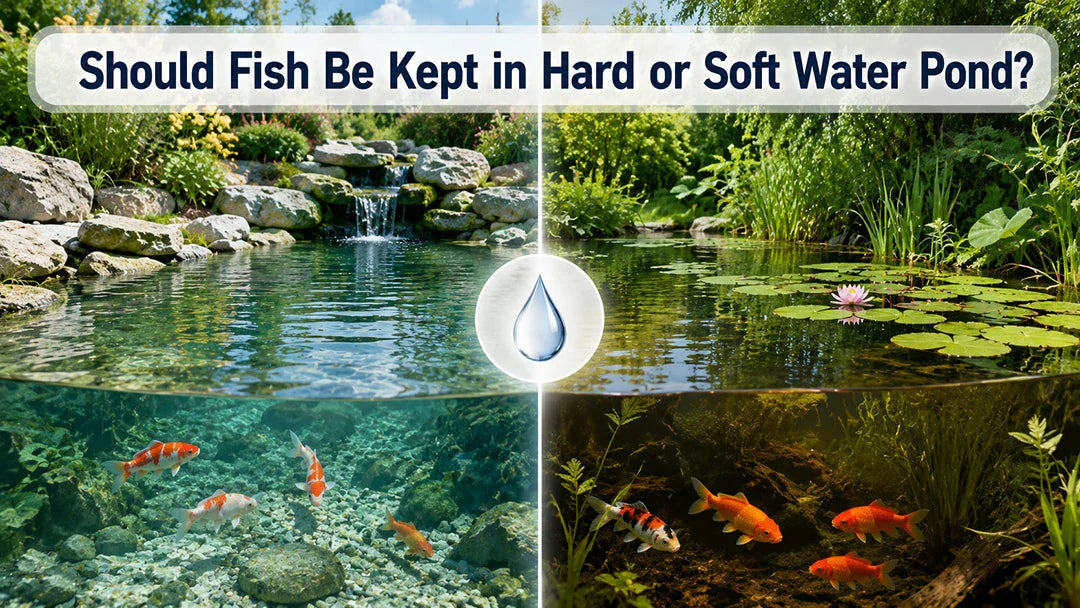
Pond fish keepers are often confused with the information they are given on hard or soft water. Some say hard water is bad for fish. Others say that soft water is better for fish. Confusion is understandable because most information is misleading. The truth is simple: different fish have different preferences.
In the following sections of this article, we will cover what exactly hard water and soft water are, whether hard water is bad for fish, the comparison of fish preferences, and koi pond water hardness.
Understanding Hard Water and Soft Water: Is Hard Water Bad for Fish?

Hard water is defined as the amount of dissolved minerals found within the water. The two main minerals found in hard water are calcium and magnesium. These two minerals are found naturally within the soil and rocks.
- Hard water has a higher mineral content than soft water.
- GH (General Hardness) measures the amount of dissolved calcium and magnesium.
- KH (Carbonate Hardness) measures the buffering capacity.
The question most pond fish keepers want to have answered is: is hard water bad for fish?
Hard water is not bad for fish. In fact, hard water helps to stabilise pH levels within the pond.
According to The Ohio State University's water quality guide for fish farmers: proper levels of alkalinity will prevent pH problems. Stability is what plays the biggest role in fish health, not whether the water is hard or soft.
Soft water, on the other hand, is not necessarily good water, either, as the buffering action of water with lower mineral levels means that there is a greater risk of a shift in the pH levels, which could cause undue stress on the fish unless closely monitored.
The key message: water balance is far more important than water type. A solar fountain can support this balance by adding gentle water movement without changing the pond’s mineral hardness.
Fish That Like Hard Water vs. Soft Water
Fish are available that have been bred for life in different environments, some of which are rich in minerals and some that are not.

Fish That Like Hard Water
There are a number of fish that are well adapted to life in a harder water environment, and some of the most common of these are:
- Koi
- Goldfish
- Guppies
- Mollies
- African cichlids
There are a number of hard water aquarium fish that are well adapted to life in a pond, and these are likely to thrive in an environment with a harder water type.
If you live in an area where the water coming out of the taps is naturally hard, then these are good fish to consider, as there will be no need for you to constantly monitor and adjust the water type.
Fish That Prefer Soft Water
There are some fish that prefer a softer water type, and these are:
- Tetras
- Angelfish
- Discus
- Catfish
These are fish that are used to living in a river system with a naturally soft water type, and exposure to very hard water for a prolonged period of time could cause undue stress on these fish, and could also have a negative effect on their ability to breed.
If you live in an area where the water type in the pond is naturally hard, then you could find that you are having to work hard to maintain a soft water type for these fish, and that could require a great deal of chemical balancing.
It is far easier to keep fish that are naturally at home with the water type that you have available.
Koi Pond Water Hardness: How to Adjust and Maintain It

Ideal Koi Pond Water Hardness
When it comes to koi pond water hardness, stability is the most important factor. As mentioned, koi are very adaptable fish. They will live comfortably in moderately hard water. A stable level of KH will prevent a pH crash. A pH crash is a sudden change in acidity level. This can cause serious stress or death among koi.
The Ohio State University guide, as mentioned in the link provided in the previous section, stresses the importance of adequate levels of alkalinity in pond water. This is essential in protecting koi from a pH crash.
Testing Hardness
A simple GH and KH test kit is recommended. Testing once a month is recommended if the pond is stable. However, it is recommended to test regularly if it is rainy, if there are big changes in pond water, or if it is a seasonal change.
Increasing Hardness
If the water is too soft and unstable, here are some methods to increase it:
- Crushed coral is a good source of calcium.
- Limestone rocks are recommended to be placed in the filtering area.
- Use buffering products carefully and gradually.
- Make changes slowly. Sudden increases in hardness can stress fish.
Lowering Hardness
It is a bit difficult to lower the water hardness. However, here are some methods recommended:
- Mixing with filtered or RO water.
- Diluting with rainwater that has been tested.
It is recommended to avoid lowering the water hardness, as it may cause more serious stress among koi than a slightly elevated mineral level.
Supporting Long-Term Water Stability
The stability of water is important. Water hardness is only one factor. Circulation and filtration are also important. A solar fountain can help keep pond water moving, supporting oxygen exchange and reducing stagnant areas.
It also ensures the continuous flow of water, which prevents stagnation and promotes beneficial bacteria, which help break down fish waste. The Poposoap Solar Pond Filter Fountain, for example, allows for the continuous flow of water and the simultaneous maintenance of water filtration. This promotes the maintenance of a balanced environment within the pond.
Effective water filtration also promotes the reduction of ammonia levels. The lower the level of ammonia, the lower the level of stress. The lower the level of stress, the higher the level of immunity.
Conclusion
While the debate between hard and soft water is a significant issue, the debate itself is also simplistic. Hard water is not necessarily bad for the fish, and soft water is not necessarily good. The key here is the maintenance of a stable environment and the ability of the water to buffer and maintain the balance of the ecosystem.
If you have koi, the key here is the maintenance of balanced koi water hardness and buffer capacity. It is also important that you do not make sudden chemical changes. Poposoap has been able to serve 2 million households by providing lightweight construction and decoration for your garden water features. The key here is the maintenance of stable water conditions, which is helped by the use of reliable water and pond equipment. (such as Poposoap's waterfall kits with filtration)
If you would like to know more about the management of water chemistry, you may continue reading here: Pond Water pH Guide.

P3203 20W 280GPH Solar Pond Filter Fountain
$119.99
Clean and oxygenate your pond with this 20W solar pond filter pump. Eco-friendly 280GPH flow ideal for small to medium backyard water features.
Frequently Asked Questions
1. Is Hard Water Bad for Fish?
Hard water is not necessarily bad for fish. In fact, hard water is generally safer than soft water.
2. Can Koi Live in Hard Water?
Yes, koi can live in hard water. In fact, koi tend to thrive in hard water.
3. How Often Should I Test My Pond Water Hardness?
It is usually recommended that you test your water hardness once a month.
4. Should I Quickly Change Water Hardness if the Numbers Are Off?
No, you should not. It is always best to make gradual changes rather than sudden chemical changes.

Leave a comment
All comments are moderated before being published.
This site is protected by hCaptcha and the hCaptcha Privacy Policy and Terms of Service apply.