

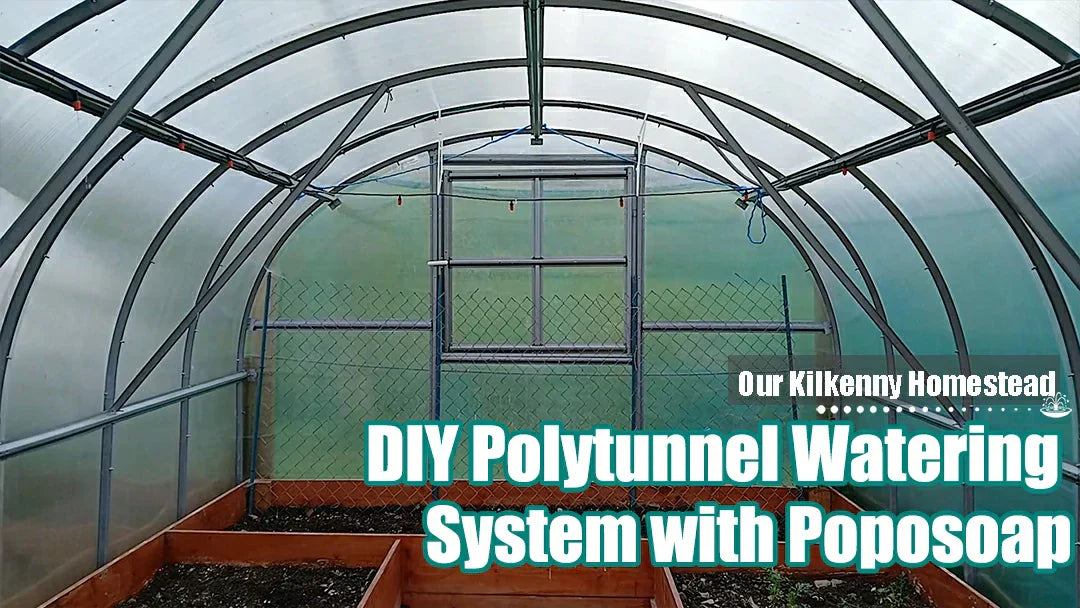
The process of watering plants under a polytunnel sometimes seems like an everyday task. Heat tends to build up quickly under the tunnel, and the compost tends to dry out much quicker than anticipated.
Even missing one watering session might hinder the growth of the plants or stress the young seedlings.
In the video presented by @ourkilkennyhomestead2006, it is evident that a solution to this problem is clearly presented and understood.
The solar pump, which is commonly used to power ponds, is used here to create an effective and easy system to water plants under the polytunnel, which is achieved through effective planning and ingenuity.
This is a solution to the problem of how to water plants under a polytunnel, and it is done through the use of solar power and remote control systems, which greatly alleviate the pressure experienced when it comes to everyday growing.
Why a Solar Watering System Works So Well in a Polytunnel
A polytunnel is a safe space for plants to grow.
At the same time, the space is hot and loses water faster. Plants may require less water but more often.
Manually watering the plants daily is a tedious process that is likely to be forgotten.
The solar-powered system is suitable for the space.
The system uses the sun, which is most powerful on days the plants require the most water.
There is no need to worry about electricity and long extension wires that are usually used outdoors.
The system in the video is designed with daily activities in mind.
- Stores water in a container
- Uses a solar pump to move water
- Operates through a remote control
- Allows convenient watering from a distance
This is important on busy days, early mornings, and rainy days.
The solar-powered system is suitable for growers who like eco-friendly products.
The system is environmentally friendly and suitable for off-grid gardening.
How the System Is Built: Simple Parts, Clear Purpose
The Solar Pump at the Center

The center of the system is the SPF326 20W Solar Pond Filter Fountain.
Although it is used in ponds, the main function of the pump is to circulate water.
In the system, it draws water from a container, then circulates it out to the watering hoses.
The pump's rate of flow, or the amount of water it can circulate in an hour, is 280 gallons.
The pump circulates water gently, perfect for grow bags or raised beds.
The water circulates gently, not washing away the soil, yet still reaching the plants.
The filter, which is a piece of sponge, helps keep the pump clean.
The pump uses the filter to clean the water as it circulates.
The filter catches dirt in the water, protecting the pump.
Since the pump uses rainwater, which can have some dirt in it, the filter is useful.

SPF326 20W 280GPH Solar Pond Filter Fountain
$119.99
Clean and oxygenate your pond with this 20W solar pond filter pump. Eco-friendly 280GPH flow ideal for small to medium backyard water features.
Solar Panel Placement
The solar panel is placed outside the polytunnel.
The polytunnel covering reduces the strength of the light.
Therefore, the solar panel is placed outside to keep the pump running smoothly.
The length of the cable makes it easy to position the pump anywhere in the garden.
When the sun hits the solar panel, the pump immediately springs to life.
There is no complicated procedure.

Remote Control for Easy Watering
One of the main features of the system, as shown in the video, is the remote-control feature.
The system can be turned on or off by a simple wireless switch.
The pump can run for short periods rather than long hours.
The feature prevents the gardener from having to walk on wet ground or disturb the plants.
Although it is a small feature, it makes the system easy to use.

Practical Benefits for Everyday Growing
Saving Time and Reducing Effort
Consistency is important in the care of plants.
The solar watering system ensures that the plants receive water in the right amounts.
Every plant receives almost the same amount of water.
The gardener does not have to carry watering cans.
Instead, the gardener checks the moisture levels and operates the system only when necessary.
This saves time during the week.
Better Water Control
The plants receive water close to the roots.
There is little splash and less waste.
This is especially important during the summer months when the rate of evaporation is higher.
Because the flow of the pump is controlled, the plants cannot be flooded.
The plants receive constant moisture at all times.
Quiet and Low-Maintenance Use
The solar pump is quiet.
There is no noise from the motor.
This is especially important in the polytunnel, where the environment is peaceful.
The system is easy to maintain.
The filter sponge requires only occasional cleaning.
The solar panel only needs cleaning from time to time to remove dust and algae (green growth).

Adapting the System for Different Polytunnel Sizes
Smaller Polytunnels
In a small polytunnel, one pump and one watering line may be sufficient.
The water may be directed to the most important plants.
The system is clean and easy to use as the plants grow.
Larger Growing Areas
In the case of large polytunnels, the same pump may be used with split lines.
The split line is used to divide the flow of water.
This allows the gardener to water several plants at the same time.
The gardener may add extra tubing as needed.
The pump does not need to be changed as the system grows.
In spring and summer, the sun shines brightly.
During the winter season, the length of the watering session may be shorter.
If the system is not required during winter, the pump can be lifted out of the water and placed indoors.
This will prolong the life of the pump.
What This User Story Reveals About Poposoap
This user story reveals the versatility of Poposoap products.
The SPF326 solar pump is not just a water pump for ponds or water fountains.
It’s a solar-powered solution for gardening needs when the user thinks outside the box.
From a brand perspective, it’s the simple things in life that matter.
Making the movement of water easy and efficient. Let the user decide how this is done.
This user story reveals that technology for gardening does not have to be complex.
A simple solution and the right placement of the solar panel mean the solar system becomes an integral part of the user’s daily routine without hassle.
Conclusion: A Calm and Pragmatic Solution for Watering Plants
The DIY polytunnel watering system above illustrates the potential of solar power in making gardening easier.
It’s an efficient combination of solar power, simplicity, and practicality.
This leads to less work with the same results: healthy plants growing in the polytunnel.
The solar pump makes it easy for gardeners to create a system that works efficiently with the SPF326 solar pump.
It’s a solution for small homesteaders or busy gardeners with a polytunnel.
This leads to healthy growth with minimal work involved.
It’s also a metaphor for the potential of water products: one product with many uses.
That’s what makes the user story above so relevant.
READ MORE: Building a Solar-Powered Backyard Mini Pond
Frequently Asked Questions
Why use a solar pump for polytunnel watering?
It’s eco-friendly, wire-free, and works when plants need water most.
Where to place the solar panel for best performance?
Install it outside the polytunnel for maximum sunlight exposure.
Is the solar watering system easy to maintain?
Yes, clean the filter and solar panel occasionally for upkeep.



Leave a comment
All comments are moderated before being published.
This site is protected by hCaptcha and the hCaptcha Privacy Policy and Terms of Service apply.